The Case for Kurdistan
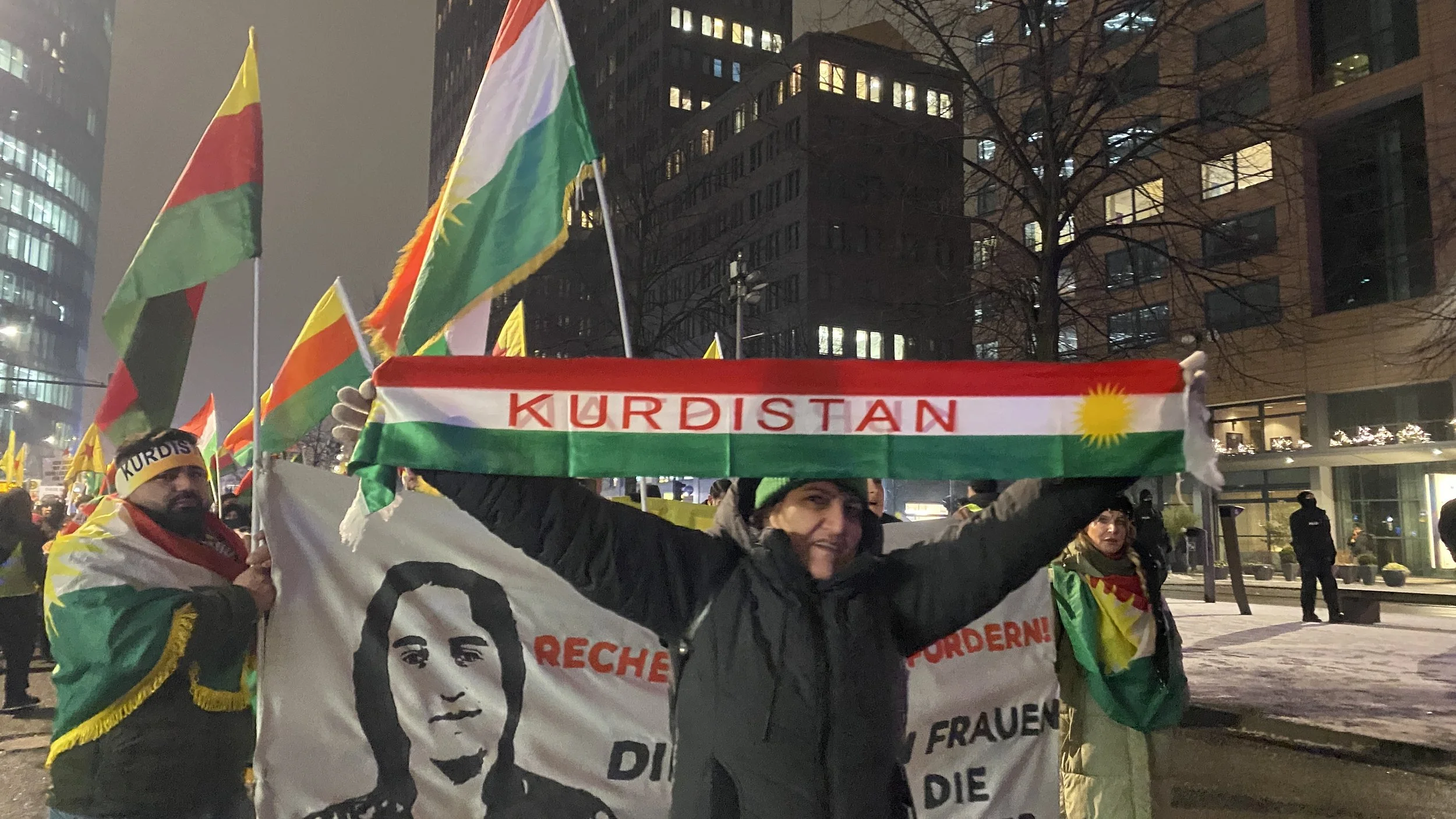
At a protest in Berlin, Germany, a Kurdish woman expresses pride and solidarity due to the recent events in Northeastern Syria
By: Daniel Miller
2/19/2026
On a main street in southwest Berlin, chants of “Jolani, terrorist! Erdoğan, terrorist” drew the attention of bystanders as they watched Kurdish protesters denounce new Syrian President Ahmed al-Sharaa and Turkish President Erdoğan’s attempts to ethnically cleanse the Kurdish people, along with Assyrians and Yazidis, from the autonomous Rojava region in Northern Syria. U.S. President Trump recently announced that, for the second time since 2019, he would be abandoning the Syrian Kurds – a key ally that was instrumental in the territorial defeat of ISIS.
Trump’s unsurprising betrayal may be immoral and shortsighted – as is most of his decision-making – but it does fit into a long-standing realist framework of American foreign policy of prioritizing unified central governments in the name of stability. “The US has always prioritized relationships with central governments when possible,” said former U.S. Army Colonel Myles Caggins in a recent interview. “It is very seldom that you’ll see nation-states recognize autonomous or semi-autonomous regions in other nation-states.”
While it may be a rare occurrence, a contemporary example of the U.S. supporting a semi-autonomous region just so happens to be the Kurds in northern Iraq, which I will discuss later in this article. But Caggins is right. Historically speaking, Western powers have sought to maintain relations with a unified central government, with the option to support insurgency or autonomous movements if the leader deviates too far away from foreign business interests, whereas authoritarian powers like Russia have always supported separatist movements because it’s easier for them to maintain power through instability.
But the case for an independent Kurdistan transcends the imperial and nationalist borders that have kept them divided for over a century. They are the world’s largest ethnic group without a country of their own – over 35 million people – and have always been treated as second-class citizens by their more powerful Arab, Turkish, and Persian neighbors. And instead of supporting an ethnic group that embraces gender equality, a multicultural society, a pluralistic government, and democratic ideals, the Western powers have instead chosen to use them as realist pawns in their geopolitical power struggles, while simultaneously claiming that the genocidal ethnostate in the Levant is “the only democracy in the Middle East.” In the past 100 years alone, the Kurdish people have been abandoned and lied to by the Soviet, British, French, and U.S. governments, have faced intense persecution by the Turkish, Iraqi, and Iranian governments, and suffered through several genocidal campaigns during Saddam Hussein’s reign of terror.
For over a century, the Kurds have been divided by artificial borders of someone else’s making and surrounded by forces that refuse to recognize the Kurds as a distinct ethnic identity. This is a common result when the ugliness of geopolitics and the poisonous mindset of extreme nationalism come together. “No friends but the mountains” has become a well-known Kurdish aphorism, and these are the many reasons why.
Turkey
In 1920, two years after the British, French, and Italian governments partitioned the collapsed Ottoman Empire with the secret Sykes-Picot Agreement, the often-cited Treaty of Sèvres promised the Kurds of Anatolia their own autonomous region, with an option for independence referendums after one year. A common misconception about this document is that it also included the other Kurdish regions of Northern Syria, Iraq, and Western Iran, but it’s a rare occurrence for nations to prioritize morality and human rights over their geopolitical power interests, and Sèvres was no exception. Despite U.S. President Wilson’s Fourteen Points peace statement alluding to the right for Kurdish autonomy, it wasn’t in the interests of the French or British to support an independent Kurdistan, because a divided Kurdistan would give the Western powers leverage to counter any growing regional influence in the oil-rich region. Turkish nationalists in Anatolia, led by the revered Kemal Atatürk (his face can be seen all across Turkey, and his portrait is required to hang in the halls of government buildings), led a revolt against the same government responsible for the Treaty of Sèvres and established the Turkish Republic in 1923. The new agreement, the Treaty of Lausanne, unsurprisingly failed to recognize the Kurdish people as an ethnic group. By 1925, the amount of resentment and discontent culminated in a rebellious Kurdish nationalist movement led by Sheikh Said that was subsequently crushed two months later.
Throughout the twentieth century, the Kurdish language, culture, and history were suppressed by the Turkish government and continue to this day under the leadership of President Recep Tayip Ergoğan. Holding power first as prime minister in 2003 until becoming president in 2014, he has encroached on Atatürk’s vision of secular nationalism by integrating Sunni Islamic culture with a national Turkish identity, much the same way as Protestant Christianity in the U.S. and Orthodox Christianity in Russia and Serbia. The Kurdish flag is banned. Mandatory portraits of Atatürk are seen in the halls of every government building, as he reminds Kurdish politicians and civil servants why they aren’t governing themselves.
Removal of Kurdish mayors has also been common, with a notable recent incident occurring in 2024, when a Kurd decisively won the mayoral race in Van. The regional electoral commission initially annulled his victory and instead attempted to award victory to Ergoğan’s AKP party candidate, until the decision was reversed after violent protests erupted. Politicians have been imprisoned on dubious charges of having connections to the Kurdish Workers’ Party, or PKK – a Marxist Kurdish militant group that is a designated terrorist group by Turkey and its Western allies. Founded in the late 1970s by Abdullah Öcalan in response to systemic Kurdish oppression, the PKK has repeatedly fought against the Turkish military, which has left tens of thousands of civilians dead and even more displaced. Since Ergoğan controls a tight grip on the media, many of the details have either been greatly obscured, underreported, or unreported.
Through collaboration with the C.I.A., Abdullah Öcalan was abducted in Kenya and flown back to Turkey in 1999, where he was charged with treason and leading a terrorist organization. After a trial that was widely criticized by several human rights organizations and later declared a violation of human rights by the European Court of Human Rights, Öcalan has spent the 21st century in isolation on Imrali Island in the Sea of Marmara. He remains the face of the PKK, which continued to have sporadic fights with the Turkish government until February 2025, when he called on them to disarm and disband.
His request came a few months after Syrian dictator Bashar al-Assad was overthrown in the country’s first successful coup attempt since his father Hafez assumed power in 1970. While the Kurds faced heavy oppression under the Assads, by 2014, the country had plunged into a devastating civil war, so Assad agreed to recognize Kurdish autonomy in Northeastern Syria if they agreed not to attack his military and view ISIS as a common enemy. The region was named Rojava, and it served as a safe haven for PKK members to hide and conduct business. After Bashar fled to Russia, Jolani assumed power. Because his vision of a unified Syria aligned with Turkey and the West, he and Ergoğan quickly turned their attention to the northeast since there was no retaliatory threat from Russia, Iran, or Assad. With its fragile regional partner on life support, it seems like it was in the best interests of the PKK to lay down its arms.
Syria
After France had ended its occupation after World War 2, Arab nationalists soon took power and imposed autocratic rule throughout the country. In 1963, members of the Ba’ath Party, a pan-Arab political party driven by nationalism and anti-imperialism that was deeply inspired by European fascism, assumed power after its military wing initiated one of the many bloodless coups that would follow over the next seven years. In 1970, Hafez al-Assad initiated the final coup of the century and would rule until his death in 2000. Bashar, his second-oldest son, assumed the presidency. The Kurds were heavily oppressed under Ba’athist rule in both Syria and Iraq. They weren’t viewed as citizens and treated as a nuisance, which made it impossible for them to own land, travel, legally work, or access higher education. Their language was banned, and any kind of cultural gatherings were criminalized. There was no state protection, and many of them suffered, died, and disappeared as a result.
Throughout the early 2010s, waves of pro-democracy protests called the Arab Spring swept across North Africa and into the Middle East. While most of the countries’ leaders affected by the protests managed to maintain both power and stability in the end, Assad only managed to do one of them. With the simultaneous development of Islamic terrorist groups spreading from Iraq after the U.S. overthrew its Ba’ath Party leader, Saddam Hussein, the Islamic State of Iraq and Syria emerged as the most extreme and brutal. Syria was a failed state held together with support from Russian dictator Vladimir Putin.
As opposition groups took up arms against the Assad regime, Kurds in the northeast formed the People’s Protection Units, called the YPG, in 2011. In January 2014, taking advantage of a fractured Syrian state and receiving the full support from the U.S., the Syrian Kurds proclaimed Rojava a self-governing autonomous status, and a federated status two years later. Maintaining the position of self-governance within recognized Syrian borders instead of declaring independence was critical because it allowed the U.S. to still support them in the fight against ISIS without angering NATO member Turkey and its powerful military. While it would make logical sense for Erdoğan to align with the undesirable YPG during this critical juncture in history, doing so would only embolden Kurdish separatism in both countries and risk regional destabilization.
As a way of thanking the YPG for playing an instrumental role in defeating ISIS, Trump withdrew U.S. troops from several border regions, allowing the Turkish military to masscre those standing in their way as they overthrew local governments along the border – creating a “buffer zone” between the YPG and PKK – and installed puppet leadership that would keep a closer eye on border crossings and PKK activity.
Whether or not Trump withdrew as a favor for Erdoğan is up for debate, but there aren’t many other explanations before entering the land of conspiracy theories. The move also heavily favored another nationalist authoritarian thug, Vladimir Putin, allowing him to spread Russian influence in the region by making a protection deal with the YPG. The deal also allowed Assad to move his troops to Rojava so Turkey wouldn’t attempt to annex more territory. The U.S. lost strategic leverage, and Assad’s brutal regime regained control of valuable oil fields. The move drew mass condemnation from both parties in Washington at a time when some of the Republicans still had a tiny bit of courage left to challenge Donnie Dictator, while Secretary of Defense James Mattis resigned in protest.
Iraq
While Erdoğan may be against the Kurds in Turkey and Syria, you will see Turkish flags lining the streets of Erbil on the rare occasions when he visits Iraqi Kurdistan’s burgeoning capital city. This is because he needs the Iraqi Kurds to act as a safeguard against Iraqi and Iranian influence while also needing an ally to help fight the PKK, which also operates in the region’s north along the borderlands with Turkey in the Qandil Mountains. Turkey not only benefits militarily, but economically as well, since it maintains access to that sweet Kirkuk oil, no matter if either Iraq or Kurdistan controls the city. In return, the Kurdistan Regional Government, or KRG, receives foreign investment from Turkey, which is also its biggest trading partner.
My arrival in Erbil came just months after Iran fired eleven ballistic missiles at a single residential building in January 2024, assassinating a wealthy Kurdish businessman and three others, including his daughter, and justifying it by claiming the building was acting as an intelligence headquarters for Israel’s Mossad. While relations are the best they’ve ever been with Iraq, there are still major disputes over control of oil fields and the share of generated oil revenue.
Written under the auspices of the U.S. in 2005, the Iraqi constitution recognized Kurdish autonomy, but not independence. The move was a giant leap forward for Kurdish self-determination, ever since the British created Iraq’s modern borders at the expense of the Kurdish people. This naturally created resentment against the British-controlled Arab monarch and later against Iraqi Ba’ath Party rule, which split from Syrian Ba’athists in the 1960s after also initiating a successful coup and shifting the regional geopolitical power alignment in Russia’s favor. Throughout the Cold War era, protests and rebellions were met with full force, no matter which dictator or Western puppet was in charge. The series of rebellions in the ‘60s and ‘70s was emboldened by ongoing border skirmishes along the Persian Gulf and supported by both the Shah of Iran and the U.S. under Secretary of State Henry Kissinger, until the signing of the Algiers Agreement ended the disputes between the two countries. Before the ink was dry, both countries withdrew their support, leaving thousands to be slaughtered. When confronted with this shameful series of events, Kissinger, in hard-realist fashion, responded to critics by saying that “covert action should not be confused with missionary work.”
1979 was a pivotal year for the region. First, the secular Pahlavi dynasty was overthrown and replaced by the theocratic dictatorship of the Ayatollah Khomeini. Later that summer, Saddam Hussein committed one of the most chilling party purges in recorded history. His totalitarian regime terrorized every Iraqi citizen regardless of ethnicity and struck fear into fellow Ba’ath Party members. While the Ba’ath Party’s creation was inspired by fascism, Saddam was also a deep admirer of Josef Stalin’s totalitarian republic of fear, creating a sadistic system built on the worst authoritarian and fear-inducing elements from both ideologies. To further solidify his legitimacy with the entire Shia population, Khomeini encouraged Islamic uprisings in Iraq’s majority Shia population to overthrow Saddam and replace pan-Arab secularism and all Western-aligned governments with Shia clerical rule.
Saddam retaliated by invading Iran in 1980, looking to seize an Arab-majority, oil-rich province, which would give him more control over the Persian Gulf. A war that he predicted would last a few weeks quickly turned into eight gruesome years of violence and instability. A war that had the support of the U.S. and other Western allies because they had lost de facto control over Shia influence in the region and viewed it as a way to curry favor with Saddam and the Arab world so that Iraq would align itself with the West once more. But there is no negotiating with fascists. They will do what they want as long as they think they can get away with it. They take what they want and then argue with everyone else over who gets what little is left. Saddam controlled one of the world’s most powerful militaries at the time and viewed the region as Arab land and the oil fields as his personal responsibility. He also possessed a major stockpile of chemical weapons of mass destruction that he used to murder over 100,000 Kurds from their rural homes in 1988, during the final months of his war with Iran. The Iraqi Kurds, taking advantage of a fatigued Iraq, received full military support from the Ayatollah in their fight for self-rule and hoped that they had finally found a reliable ally. As revenge against another Kurdish uprising, he unleashed a brutal genocidal campaign of chemical weapons attacks, the deadliest occurring in Halabja, where 5,000 people were killed in a single day.
It should come as no surprise to learn that the Ayatollah also abandoned the Kurds once Saddam agreed to withdraw his forces from Iranian territory. He immediately continued his genocidal campaign before moving on to annex Kuwait as Iraq’s nineteenth province. These are the main reasons why any random Kurd in Iraq will say that the genocidal madman who controlled twenty percent of the world’s oil reserves should have been deposed during the Gulf War. At a time when relations between Washington and Moscow were showing signs of improvement, the United Nations ultimately decided that Saddam was a threat to regional peace and global stability. However, instead of regime change being the objective, the U.N. approved military intervention with the intention of liberating Kuwait after Saddam refused to withdraw.
While war philosophers Saint Augustine and Hugo Grotius would have likely approved of removing Saddam, the West instead thought that his erratic and capricious behavior could be contained through sanctions, diplomacy, and routine inspections to ensure that he wasn’t developing a nuclear weapon. In their view, a centralized Iraq was more likely to maintain regional stability than to anger Saddam by supporting Kurdish autonomy. Egypt and Saudi Arabia agreed. U.S. President Bush Sr. even encouraged Shia and Kurdish uprisings, but refused to support them militarily, even after the liberation of many Shia and Kurdish towns.
He did, at the very least, allow the implementation of a no-fly zone to protect them, which enabled the Iraqi Kurds to establish the Kurdistan Regional Government in 1992, creating their first autonomous government. While the KRG showed early signs of prosperity and determination, progress was soon derailed by a civil war that began in 1994 between the KDP and PUK – the two powerful political parties led by the Barzani and Talabani families. Although the fighting ended in 1998, the KRG remains divided both administratively and militarily, with a border checkpoint in between.
By 2003, Iraq was a failed state on the brink of collapse. Saddam’s regime was crumbling around him. His sadistic sons were killed in a firefight with the U.S. military, followed by a collective sigh of relief by parents who no longer had to worry about their daughters being abducted, so Uday, the oldest, could have his way and then, depending on his mood and how much they resisted, decide to kill them or return them home in shame. No longer would brides have to risk the same threat on their wedding days. People cheered when, with the critical help of the Kurdish fighting force called the Peshmerga, the U.S. found Saddam cowering in a hole south of his hometown, Tikrit. No longer would families be forced to watch videos of their missing sons being executed, and then being given a bill to pay for the bullet. No longer would his aids worry about being executed if they positioned the hidden office cameras at unflattering angles.
Unfortunately, mere weeks after Saddam was captured, Jay Garner, the man who wanted to transition Iraq into a functioning democracy within three months, was replaced by Paul Bremer, who had other ideas in mind. Unlike Garner's ambitious vision, Bremer criminalized the Ba'ath Party and banned its remaining members from holding office, and he also dismantled the military. These two catastrophic decisions are never mentioned when discussing the Iraq War, and instead, the blame is simply placed on the fact that Saddam was overthrown. As soon as the decision was made, 400,000 soldiers suddenly found themselves without a job or institutional support in an environment where religious extremist groups are always hiring.
In 2005, as the situation in Iraq was beginning to stabilize, the Iraqi constitution recognized the KRG’s semi-autonomy within its borders, with Masoud Barzani serving as president until 2017. While previously hostile towards Kurdish self-governance of any sort, the Turkish government began building relations with the KRG for several important reasons. Now that Kurdish self-rule was legitimately recognized, the risk of a PKK uprising had greatly increased, so diplomatic and economic ties were soon negotiated.
The next ten years were one of the darkest periods in the history of the Fertile Crescent. The ensuing civil war and territorial disputes between extremist groups failed to spill over into Iraqi Kurdistan, but the threat of insurgency was always high, and still is to this day. On September 25, 2017, less than three months before the Iraqi government declared territorial victory against ISIS with the help of the Peshmerga and U.S., the KRG held an independence referendum that passed with 93 percent in favor. The move was declared illegal by the Iraqi government and condemned by the U.S. and other Western powers, including Turkey. Instead of recognizing the democratic will of the Kurdish people, the U.S. and its Western allies made no effort to stop the Iraqi military from punishing the KRG by retaking the critical city of Kirkuk. While it may have been in the best interest of regional stability not to recognize the KRG’s independence referendum, the U.S. could have easily leveraged the outcome to advance Kurdish interests more broadly. The Kurds were once again abandoned. Despite this snub by the Americans, the KRG still openly embraces the presence of a U.S. military base and the construction of a massive new consulate in Erbil.
Iran
Less than 300 kilometers to the east, in Iran, sits the city of Mahabad, which was the capital city of the 1946 short-lived Republic of Mahabad, whose military force, the Peshmerga – meaning “those who face death” – was commanded by Barzani’s father, Mustafa. Its president was Qazi Muhammad, a slender socialist who ideologically rejected imperialism and pragmatically embraced the tenuous support of Josef Stalin and the Soviet Union. During World War 2, the Soviets jointly occupied the whole of Iran with the U.K. and the U.S. to secure supply routes from the Persian Gulf through the Caucasus. Stalin had made an initial pact with the Allies to make a complete withdrawal after Hitler blew his brains out, yet refused to do so after the West honored its part of the agreement in August 1945. Instead, he encouraged Kurdish and Azeri uprisings in the north as a way to project Soviet power into the Persian Gulf, in what could be considered the first provocative spark that ignited the Cold War.
Stalin’s geopolitical interests didn’t include protecting Kurdish sovereignty; he initially supported the Republic of Mahabad because he thought he could later convince Qazi Muhammad to integrate into the neighboring Azerbaijan People’s Government, but to no avail. By mid 1946, Soviet troops were completely withdrawn from both of the nascent self-governing entities, which allowed Iran to easily reassert its control over the northern region by December that year. Qazi Muhammad was hanged while Mustafa Barzani and the Peshmerga fled back to Iraqi Kurdistan. The Mahabad experiment was over.
The following generations of Iranian Kurds have been met with fierce oppression and discrimination. The Shah’s land reforms in the following decades did little to benefit the Kurdish peasants. The Kurdish language was banned, and he deliberately kept the region economically underdeveloped relative to the rest of the country as a means of restricting the capacity for any burgeoning political movements. After the 1979 Islamic Revolution, many Kurds had initially hoped for greater autonomy under Khomeini's new order, only to have been met with an order of jihad. Throughout the 1980s, intense clashes ensued. Many prominent Kurdish political figures were executed, and the concurrent war with Iraq carried even more hardships and instability along the border. All of these events took place during a time when Khomeini was simultaneously supporting the Iraqi Kurds in their fight against Saddam, while Saddam was supporting the Iranian Kurds in their fight against Khomeini. The following decades for the Kurds were met with systematic oppression, as many political activists, journalists, and teachers faced imprisonment and execution. The Kurdish language and cultural expressions were banned.
Kurdistan
The case for Kurdish self-governance goes well beyond a cursory understanding of their history of abuse and oppression. The cultural aspect is something that can only truly be felt by visiting the region, as I have done so within Turkish and Iraqi borders. They have immense pride in the fact that their ancestors gave their lives to keep the idea of Kurdistan alive and carry that same willingness to face death for the same cause, despite the odds being perpetually stacked against them.
Not only should it be considered a moral obligation of the West to right the wrongs of past betrayals, but the Kurds have consistently proven to be natural Western allies who fight for the same secular, democratic, and multicultural ideals in a region filled with religious and nationalist extremists who wish to see them disappear by any means necessary. Even the most hardened realist has to acknowledge that supporting Kurdish self-rule is the best way to maintain regional stability since they have a steady track record of loyalty and advancing human rights among a perpetually destabilizing Sunni-Shia rivalry, where both sides wish to impose their fundamentalist interpretations of sharia law.
There is also good reason to suspect that the West's persistent reluctance to support Kurdish self-rule is rooted in its Cold War mentality of halting the potential spread of anti-capitalist intellectual movements. U.S. administrations have always fought against the same democratic ideals they claim to uphold, once profits from foreign investors are threatened at the expense of improving the lives of the people whose land they chose to exploit in the first place, as much of the Global South can attest.
I’ve heard it said by many Kurds that unity amongst them hasn’t been this strong in several lifetimes. One man at one of the Berlin demonstrations said that, after Ali Khameini’s recent communications blackout in response to nationwide protests, he hadn’t heard from any of his family for three weeks and had no idea if any of them were alive or dead. It’s time for the West to take a stand on Kurdish support and prove once and for all that they have more friends than just the mountains.